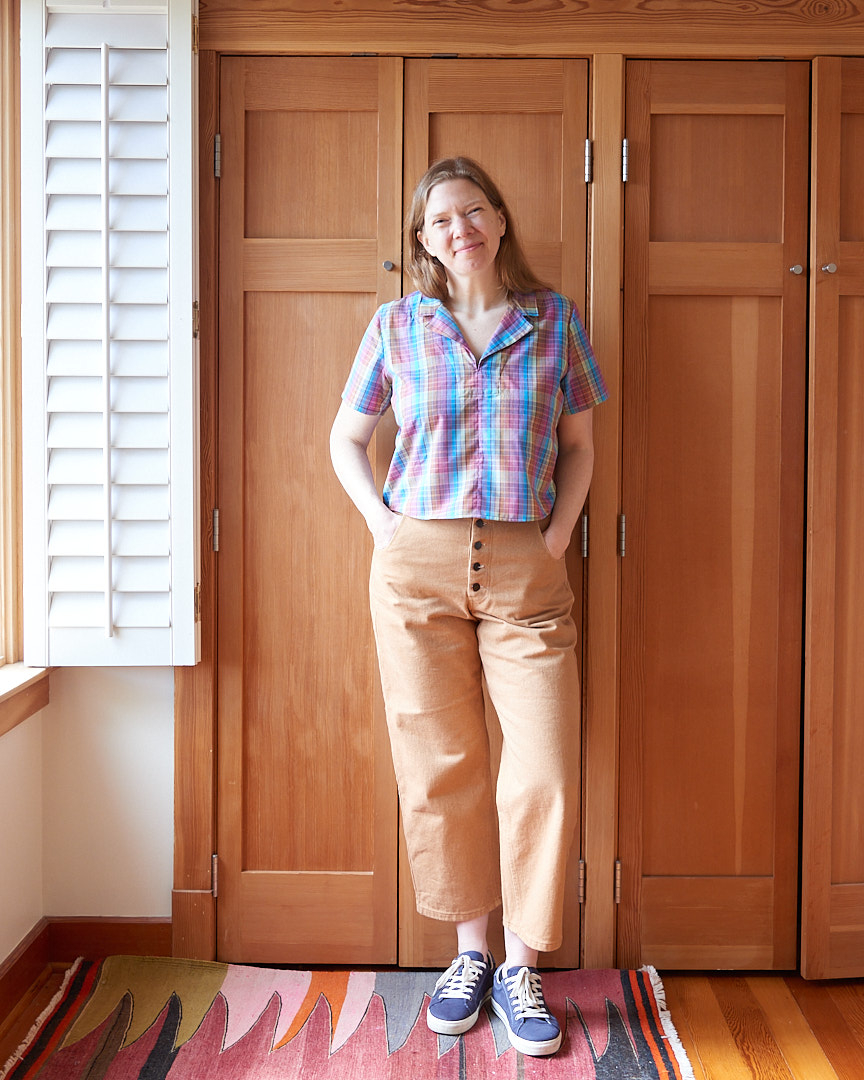
When the Donny shirt by Friday Pattern Company first came out, it didn’t grab me. The collar proportions seemed a little off to me, and I have several other “camp collar” button-up patterns in my collection already. But over the years, this pattern has amassed a mountain of online hype, and there are hundreds (thousands?) of cute versions on social media. So I decided to give in to the peer pressure and try it.
The Perfect Notched Collar
I’ve written about notched collars before, but there are several factors that can dramatically change the way a notched collar looks on a shirt. The size of the collar and lapel as well as their relative proportions to each other are critical for the style. Tweaking the ratio of collar to lapel can take a shirt from quintessentially classic to over-the-top camp. The shape of the neckline “V” can also impact the look, whether it’s narrow, wide, plunging, or high.

Once you start looking at notched collars, you realize that there are endless variations. I strongly prefer the styles that have a more classic and timeless look, with a slim lapel and collar. I also prefer a narrow, deep neckline.

On the spectrum of notched collars, Donny has a wider, larger collar and lapel. Although it’s not my style, sometimes I can change my own mind by making a pattern that’s a little outside my comfort zone, so I went for it.

Sizing and Fit
Donny goes up to a size 7X for a 60 inch chest. My bust/chest measurement is 39-40 inches, so I am in between the L and XL. Since there is ample ease designed into this top, I chose the size L, which gives me 6-7 inches of ease at the bust.

After wearing my Donny shirt, there are a lot of things to like about it. I made no adjustments, and I was pleasantly surprised by the overall fit. There is a generous amount of ease in the sleeve and chest, so it’s comfortable without being too oversized, and I have good arm mobility. The shoulder seam placement and the sleeve length is just right for me. And the gentle curve of the hem is also lovely.


If I were to make this top again, I might consider adding a bust dart. The only thing I don’t love about the fit is the side profile. I would like a little bit more contour over my bust so the top doesn’t flare out quite as much.

Construction
I ran into some issues with the instructions for this pattern. For starters, I have a few minor gripes about a lack of consistency and attention to detail. For example, the instructions tell you to grade the back yoke seam but not the shoulder or the collar seams, which are equally bulky.
My biggest frustration came when sewing down the neck facing. As written, the instructions will likely lead to a little bubble of fabric being trapped around the facing stitches. I dislike how this looks and feels; it’s not a nice finish on a very visible part of the shirt. I ripped these facing stitches out twice before finally realizing it was the instructions that were at fault, not me.

The problem lies in how the instructions tell us to sew the facing down. We are instructed to flip the shirt inside out, lay the lapel flat, then pin and sew:

It’s relatively straightforward to steam and pin the shirt when it’s flat like in the drawing above, then edgestitch around the facing. But once you turn the shirt right side out again, the lapel must be turned to create the roll line, and that’s when the bubble forms.

When the lapel is flat, the two layers (facing and shirt) sit against each other smoothly (above, left). When turned, the facing rolls to the outside of the curve, and the outer shirt layer rolls to the inside (above, right). Either the facing needs to be slightly bigger to wrap around the outside of the roll line, or the shirt layer needs to be slightly smaller to fit on the inside of the curve. If we’ve just sewn the two layers together when flat, the inner layer will pucker and bubble once rolled because there’s now too much surface area here.
To solve this issue, I flipped the shirt to the right side and rolled the lapel. I steamed the facing very carefully to make sure both layers of the lapel were laying together smoothly through the curve of the roll line, and then I pinned from the right side.

Next I hand basted the facing to the shirt, again from the right side. Once secure, I flipped the shirt inside out again and edgestitched the facing in place. Voila, no more puckering.

Depending on fabric choice, this puckering may be more or less noticeable in your Donny. For example, spongey fabrics like double gauze seem to do the best with this pattern, because the fabric can “absorb” a little excess around the lapel area. In some cases, you might also be able to steam the crap out of your fabric to slightly shrink that fabric bubble, too. Unfortunately for me, no amount of steaming would reshape the bubble in this cotton shirting, so I’m glad I found a different solution.
Final thoughts
After posting about this project on social media, dozens of other sewists messaged me to say that they encountered the same lapel bubbling issues. Many expressed annoyance at the way it looks on the final garment, and some assumed that it was just their beginner sewing skills that were to blame. A few found their own solutions and abandoned the instructions, just like I did.
In the end, despite the instructions, I like the fit and proportions of the Donny shirt, and the collar is growing on me… a little. I think it looks great on other people, but it’s just not a style that I like on myself or see myself wearing often. I may try to hack a different collar onto the Donny, or I may just move on to another pattern. The Factory top from Merchant and Mills is calling my name, and I sense a pattern comparison post in my future! 🤫


 The Crooked Hem
Leave a reply to alpacafull23d5a7752e Cancel reply